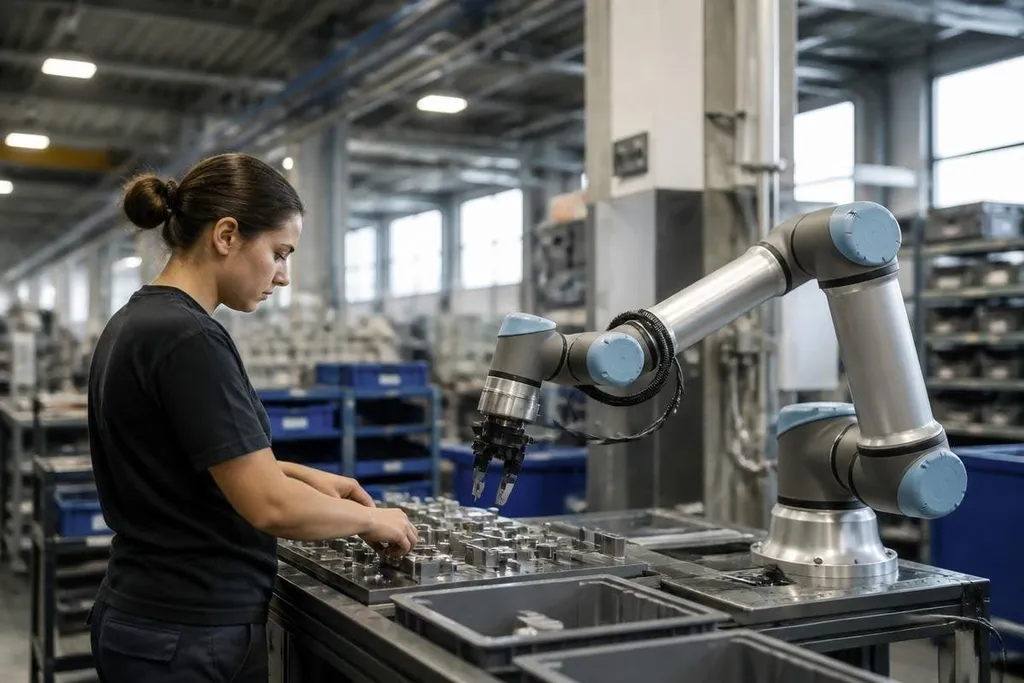
A collaborative robot, or cobot, works near people instead of behind a fixed safety fence. Its arm can handle repeated actions such as placing parts, checking surfaces, or moving items while a worker manages setup, judgment, and exceptions.
The change happens at the task level. A job may keep the same title while the robot takes over the motion that causes fatigue or slows production.
Quick read
- Cobots suit repeatable tasks where a person still needs to make decisions.
- Force sensing and speed limits help the robot work near people, but they don't remove the need for a risk check.
- The strongest projects change the work around the robot instead of dropping a robot into an unchanged process.
What the robot takes over
A cobot works best when the task has a clear start and finish. The part arrives, the arm moves to a known point, the gripper picks it up, and the next step follows a set path.
A worker can then load material, inspect the result, or handle parts that do not match the normal pattern. That split changes the physical burden of a shift.
Reaching into the same bin hundreds of times, holding a tool at one height, or moving a part between two stations can leave the person with less energy for the work that needs care. It repeats the motion while the worker watches quality and deals with changes.
The end effector, which is the tool fixed to the robot arm, decides much of the result. A gripper may pick a rigid part, while a suction tool may move a smooth surface. Changing that tool can change the task the robot can handle, so the arm itself is only part of the workplace change.
Why the job changes
Automation shifts the work toward setup and control. Someone has to teach the arm its path, set the tool, check the part position, and respond when a sensor sees something outside the normal range.
That work calls for training, but the training is often tied to the station rather than a long course in robotics. A technician may need to understand robot positions, tool changes, safety stops, and the production steps around the arm. The worker beside the robot still needs to know when the process has produced a bad part.
This is where workplace planning matters. If a company measures success only by the number of motions the robot completes, it can miss the time spent loading parts, clearing faults, or checking output. A station that removes a repetitive motion but adds constant interruptions may leave the worker with a harder shift.
A cobot can remove one motion and still leave a worker loading parts or clearing a fault. Robot 24 puts named tasks and work sites beside robot claims, so you can compare the work removed with the work that stayed. That distinction matters most when the task changes.
Where the limits remain
A cobot's ability to work near people doesn't make every task suitable. The robot still needs a known workspace, a clear tool path, and parts that arrive within the range its sensors and gripper can handle.
Safety settings can slow or stop the arm when it detects contact, a person entering a zone, or a fault in the task. Those settings depend on the arm, tool, material, and work area. A heavy part or sharp tool can change the risk even when the robot moves slowly.
It also struggles when the work changes from one item to the next. A person can adjust their grip after seeing a bent part or a loose label. A programmed arm needs a sensor, a new instruction, or a worker to take over that case.
I'd choose a cobot for a repeated task with a clear handoff, and skip it when the process changes every few seconds.
A buying and planning checklist
Use these checks before changing a station:
- Name the motion: record the repeated reach, lift, turn, or placement the robot would handle.
- Count the exceptions: note how often a person must correct the normal process.
- Check the tool: confirm that the gripper or other end effector can hold the real part, including its weight and shape.
- Map the handoff: decide where the person loads material, checks output, and takes control after a stop.
- Test the whole station: include loading, fault recovery, cleaning, and tool changes in the trial.
- Set the training need: name who will teach the arm, inspect the station, and fix routine faults.
The next useful measure is not how many robot motions replace human motions. It is whether the worker finishes the shift with fewer tiring actions, fewer interruptions, and enough control to catch the problems the robot cannot see.